


From Tourism Brochures to Binge-Worthy Narratives: The Marketing Shift
Imagine a destination management organization (DMO) in 2019. Marketing meant glossy brochures, static website imagery, expensive TV spots during peak seasons, and hoping travelers somehow stumbled across your destination among millions of competitors. Results were measurable but modest.
Fast forward to 2026. The same DMO now produces micro-dramas—short episodic narratives featuring local culture, hidden gems, local entrepreneurs, and authentic storytelling. The outcome? Measurable tourism spikes, earned media worth millions, visitor confidence restoration, and most critically: travelers actively seeking out your destination because they emotionally connected with a story, not because they saw a pretty postcard.
Destination Marketing 2.0, and it’s fundamentally reshaping how tourism authorities compete for visitor attention.
The Economics of This Shift: Data That Justifies Investment
India’s travel and tourism industry is booming. The sector generated ₹21 trillion in 2024—20% above pre-pandemic levels—and is projected to reach ₹43.25 trillion by 2034. That growth trajectory demands smarter marketing, not just bigger budgets.
Here’s what’s changed: video now drives travel decisions at every stage—from initial inspiration through final booking. Instagram steers destination choice for 42% of young travelers, converting inspiration into instant reservations. The travel industry increased advertising spend by 28% in 2024, with 78% directed to digital channels. Critically, 62% of that digital spend flows to visual-first platforms like YouTube and Instagram, with short-form video showing the strongest conversion rates.
The implications are clear: if your destination isn’t told through compelling micro-dramas, you’re essentially invisible to the travelers actually booking trips.
Real-World Impact: Three Case Studies Proving the Model
Case 1: VisitBritain’s Film Tourism Campaign (January 2025)
VisitBritain launched a campaign positioning film and TV locations as itinerary “engines” for regional dispersal beyond traditional hotspots. The result? £217 million in additional visitors spent in the first six months alone. The ROI was extraordinary: £20 in additional visitor spending for every £1 invested.
The mechanism is strategic. When potential travelers watch compelling micro-dramas featuring British locations, the narrative friction disappears. Instead of asking “where should I go?” they’re asking “how do I book the experiences from that story?”
Case 2: Shillong Cherry Blossom Festival, Meghalaya (2024)
Meghalaya’s tourism board leveraged storytelling content around their annual festival. The result: 40% increase in footfall totaling 150,000+ visitors, with particularly strong international participation. Local businesses—hospitality, food, handicrafts, transportation—reported substantial revenue gains. The festival hashtag reached millions globally, fundamentally enhancing international perception of Meghalaya as a cultural destination.
This is where destination micro-dramas intersect with the rise of vertical cinema. Vertical-format storytelling, optimized for mobile discovery, becomes the distribution engine for destination awareness.
Case 3: Gold Coast Recovery (#LOVEGC Campaign, 2025)
Post-natural disaster, Australia’s Gold Coast DMO invested in community-led marketing featuring authentic local narratives and user-generated content. Within two months, visitor confidence was largely restored. Easter bookings returned to near pre-disaster occupancy levels—critical for local hospitality businesses—and local business revenues rebounded by 15% versus post-crisis projections.
The insight: destinations that tell stories through local voices and genuine community narratives earn trust and drive conversions faster than any paid campaign.

Why Micro-Dramas Outperform Traditional Destination Marketing
The Emotional Resonance Factor
Traditional tourism marketing emphasizes features: “Beaches,” “Mountains,” “Infrastructure.” Micro-dramas ask: “What does this destination mean to people living there? What stories does it enable?”
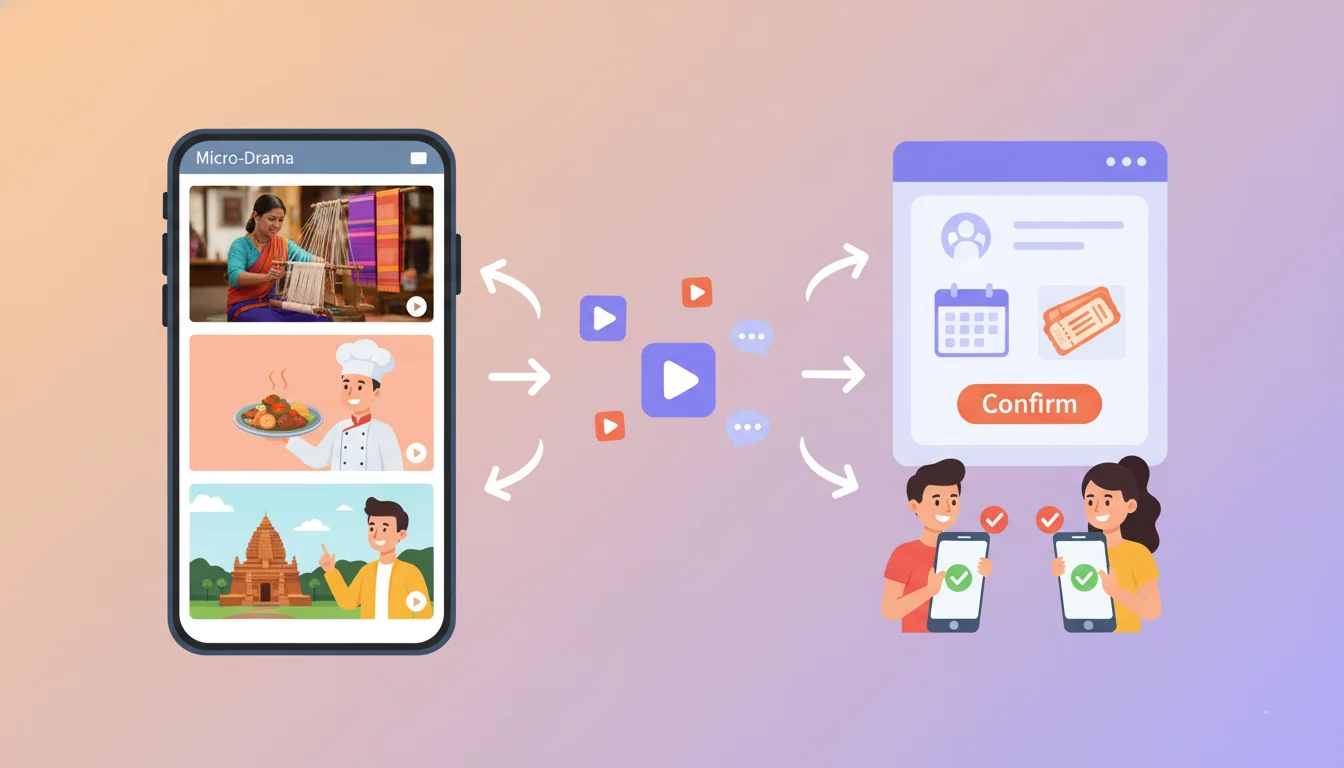
When travelers watch a micro-drama about a local artisan in Jaipur discovering her heritage craft’s global appeal, or a chef in Goa crafting forgotten regional recipes, they’re not seeing a destination. They’re experiencing a narrative about human potential, cultural pride, and authentic place-based stories. This emotional transportation shapes behavioral intent in ways static imagery cannot.
Authenticity Signals
When a DMO partners with local micro-content creators—rather than importing external production teams—something shifts. The storytelling carries credibility markers that audiences instantly recognize. A story told by someone from the community carries more authenticity than a polished campaign from a distant agency.
This principle underpins the success of destination storytelling within advertising frameworks. The mechanism is identical: human authenticity beats production polish when it comes to earning trust.
Niche Audience Precision
Rather than mass messaging hoping someone finds your destination appealing, micro-dramas enable hyper-targeting. Nature-focused micro-dramas attract adventure travelers. Food-centered narratives draw culinary tourism. Wellness stories reach the booming wellness tourism market projected at $2.1 trillion globally by 2030.
Creators understand their niches intimately. Partnering with micro-influencers and regional creators ensures message-audience alignment that traditional media buying cannot achieve.
Platform-Native Distribution
Destination micro-dramas aren’t forced into TV ad blocks or static website galleries. They live on Instagram Reels and YouTube Shorts—platforms where travelers actively discover travel inspiration. They’re designed for scrolling, clipping, sharing, and discussion. They create algorithmic momentum rather than relying on paid amplification alone.
The Practical Workflow: From Concept to Conversion
Stage 1: Identify Stories
Which local entrepreneurs, artisans, traditions, or experiences define your destination? What human stories resonate emotionally?
Understanding micro-drama’s narrative structure is critical here—each episode must deliver emotional hooks every 15-30 seconds.
Stage 2: Partner with Local Creators
Rather than hiring external production companies, identify regional creators with existing audiences in your target traveler segments. They bring authenticity, cultural fluency, and distribution infrastructure already built.
Stage 3: Distribute Across Platforms
Short-form content performs identically across Instagram Reels, YouTube Shorts, and longer-form YouTube. Some micro-dramas will naturally gravitate toward each platform. Distribution strategy follows audience behavior, not pre-conceived channel preferences.
Stage 4: Enable User-Generated Content
Encourage tourists to create their own micro-content from locations featured in your stories. This amplifies organic reach and provides ongoing content supply.
Stage 5: Package for Booking
The final critical step: ensure story locations are immediately bookable through your OTA partners. Itineraries, tour packages, accommodation recommendations—these bridge the gap between inspiration and conversion.
Overcoming the Set-Jetting Risk: Sustainable Growth
One cautionary note: destinations featuring in viral media sometimes face over tourism. Dubrovnik now hosts 36 tourists per resident, straining infrastructure. Yet destinations that plan proactively—investing in sustainable infrastructure, enabling dispersal to lesser-known areas, setting visitor caps—can manage growth.
The strategic approach: use micro-dramas to drive visitors not just to iconic locations but to secondary attractions, local experiences, and regional dispersal. This distributes economic benefits while managing environmental impact.
Conclusion
Destination marketing has fundamentally shifted from static promotion to narrative immersion. The brands and DMOs thriving in 2025 aren’t those with the biggest budgets—they’re storytellers fluent in micro-drama formats, comfortable directing local creators, and disciplined about measuring conversion from inspiration to booking.
India’s tourism market is projected to reach ₹43.25 trillion by 2034. The competition for that growth will be fierce. Destinations that embrace professional video production standards while maintaining authentic storytelling will capture disproportionate share. The era of brochures is over. The era of narrative-driven tourism has arrived.
FAQ’S
Q1. How do micro-dramas differ from traditional tourism videos?
Micro-dramas prioritize authentic emotional storytelling over promotional messaging. They’re episodic, optimized for mobile, and designed to drive behavioral intent through narrative immersion rather than feature promotion.
Q2. What’s the ROI of travel micro-drama campaigns?
VisitBritain achieved £20 additional visitor spend per £1 invested; Gold Coast saw 15% revenue growth post-campaign; Meghalaya reported 40% footfall increase. Conversion rates typically 2-3× traditional campaigns.
Q3. Which platforms work best for destination micro-drama distribution?
Instagram Reels and YouTube Shorts drive discovery; YouTube long-form for detailed research; Connected TV for aspiration-building. Cross-platform distribution maximizes reach.
Q4. How should DMOs identify which stories to tell?
Interview local stakeholders—entrepreneurs, artisans, community leaders. Focus on human narratives: heritage crafts, regional cuisine, cultural traditions, wellness practices, adventure experiences with authentic local perspectives.
Q5. What’s the biggest risk with viral travel micro-dramas?
Over tourism if infrastructure isn’t planned. Solution: design campaigns to drive dispersal to secondary attractions, partner with local communities on sustainable capacity, and manage expectations about visitor volumes.