

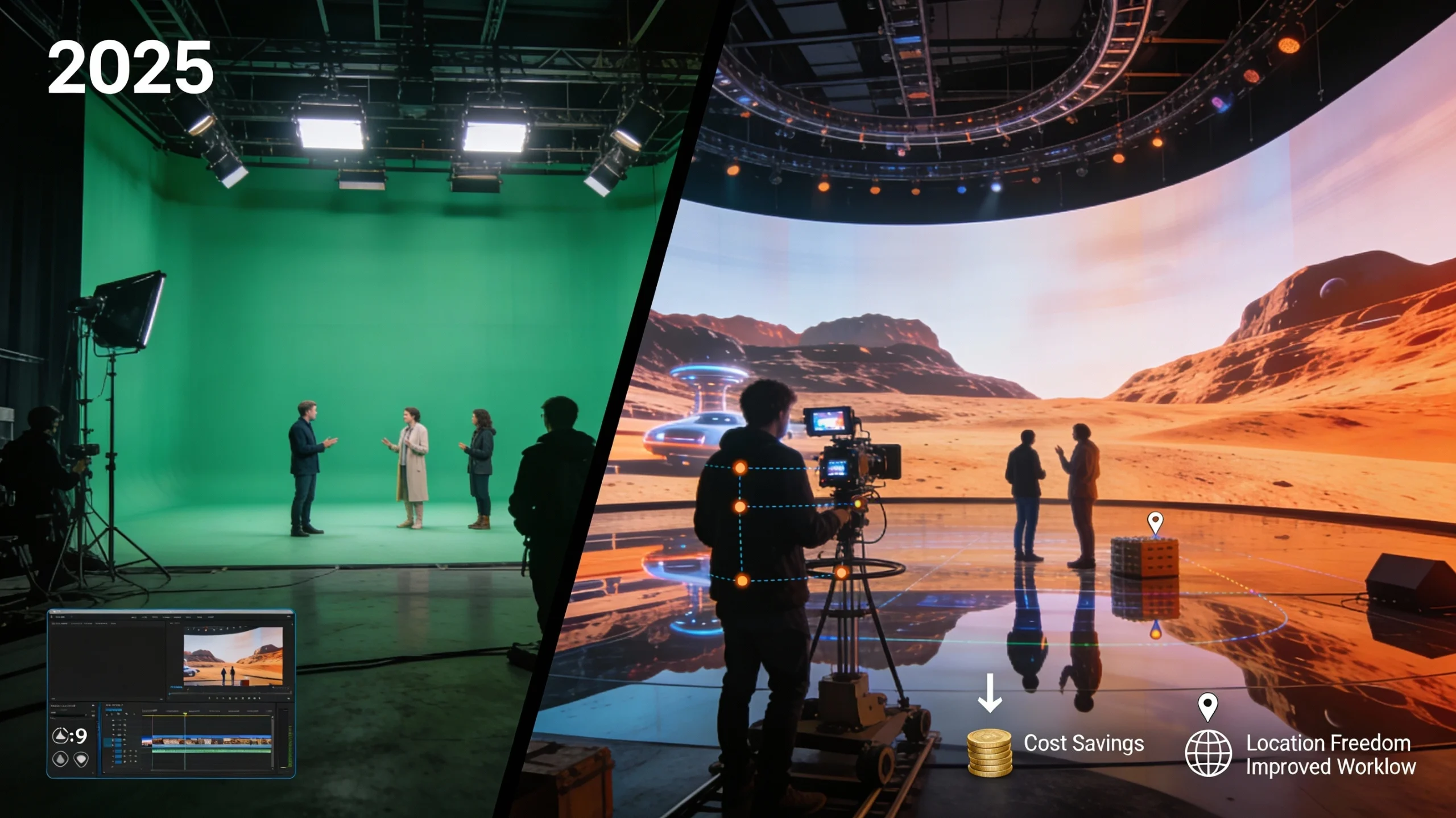
From Green Screens to LED Volumes: Why Your Next Production Doesn’t Need a Physical Location
For decades, filmmakers faced a fundamental challenge: bring your story to the location, or spend months in post-production fixing green screen compositing. But today, a revolutionary shift is reshaping the industry. LED volumes—massive LED wall installations powered by real-time rendering—are freeing productions from physical locations entirely. For studios and production houses in Delhi NCR looking to maximize efficiency, this isn’t just an upgrade; it’s a competitive necessity.
The Evolution: Why Green Screens Fell Short
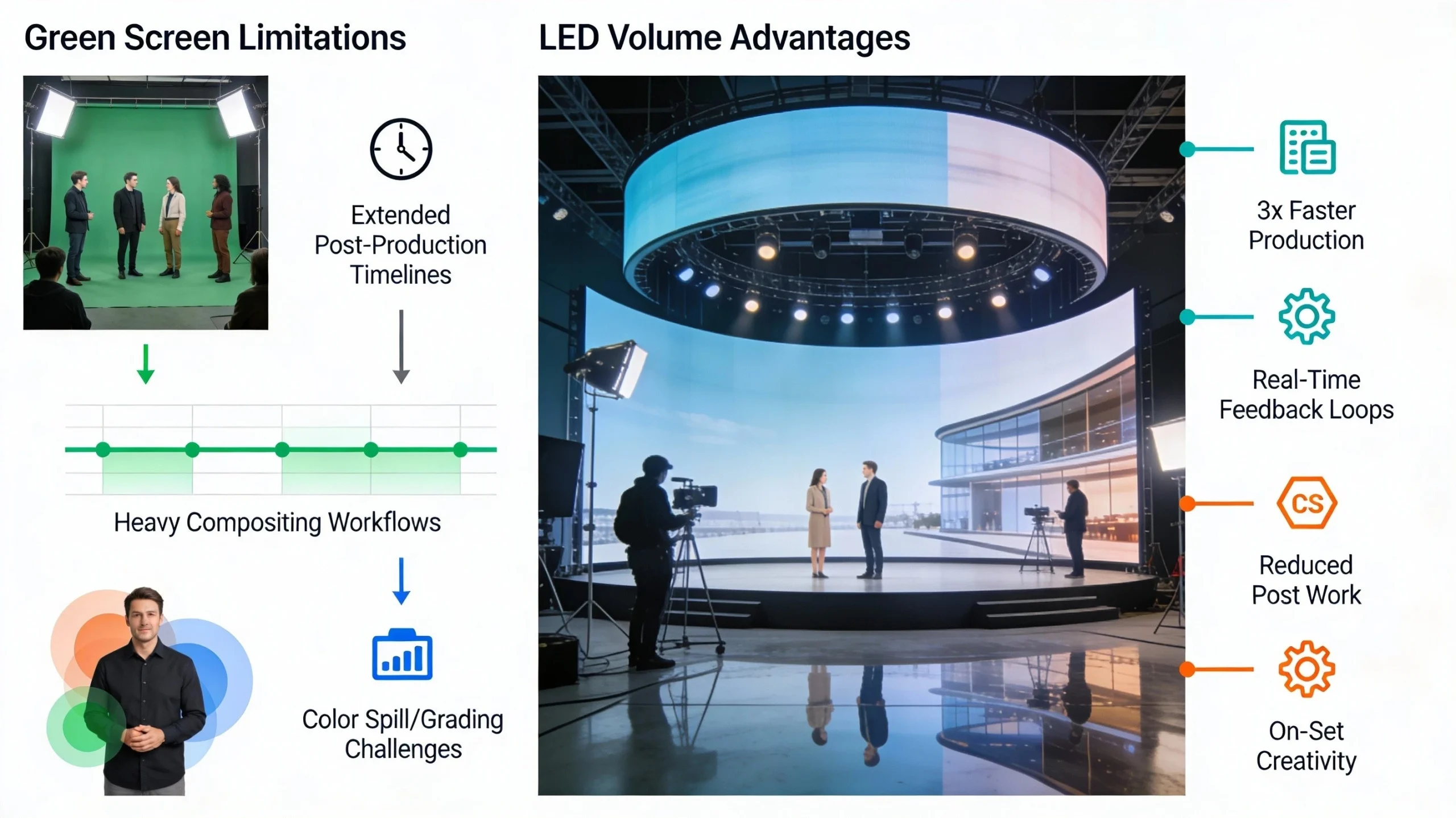
Green screen technology has served the industry well, but its limitations are undeniable. Compositing in post-production introduces latency, color grading nightmares, and the inability for actors to interact naturally with their environments. Lighting becomes a guessing game—actors can’t see reflections or shadows from their backgrounds, leading to that tell-tale “floating” quality that pulls viewers out of the story. More critically, green screen workflows extend timelines. What should take weeks in post-production often stretches to months.
This is where virtual production and LED volumes step in. Unlike traditional green screens, LED walls display real-time, interactive environments that respond instantly to camera movement. Actors see their surroundings, react authentically, and production teams capture broadcast-ready footage in a single take. The difference isn’t just technical—it’s transformative for storytelling quality.
What LED Volumes Actually Are
Think of LED volumes as cinema’s answer to immersive digital experiences. Large-scale LED wall arrays (often 10×10 meters or larger) surround a stage, displaying photorealistic environments rendered in real-time by game engines like Unreal Engine. As the camera moves, the virtual environment shifts in perfect perspective, creating genuine depth and realism that traditional compositing can never achieve.
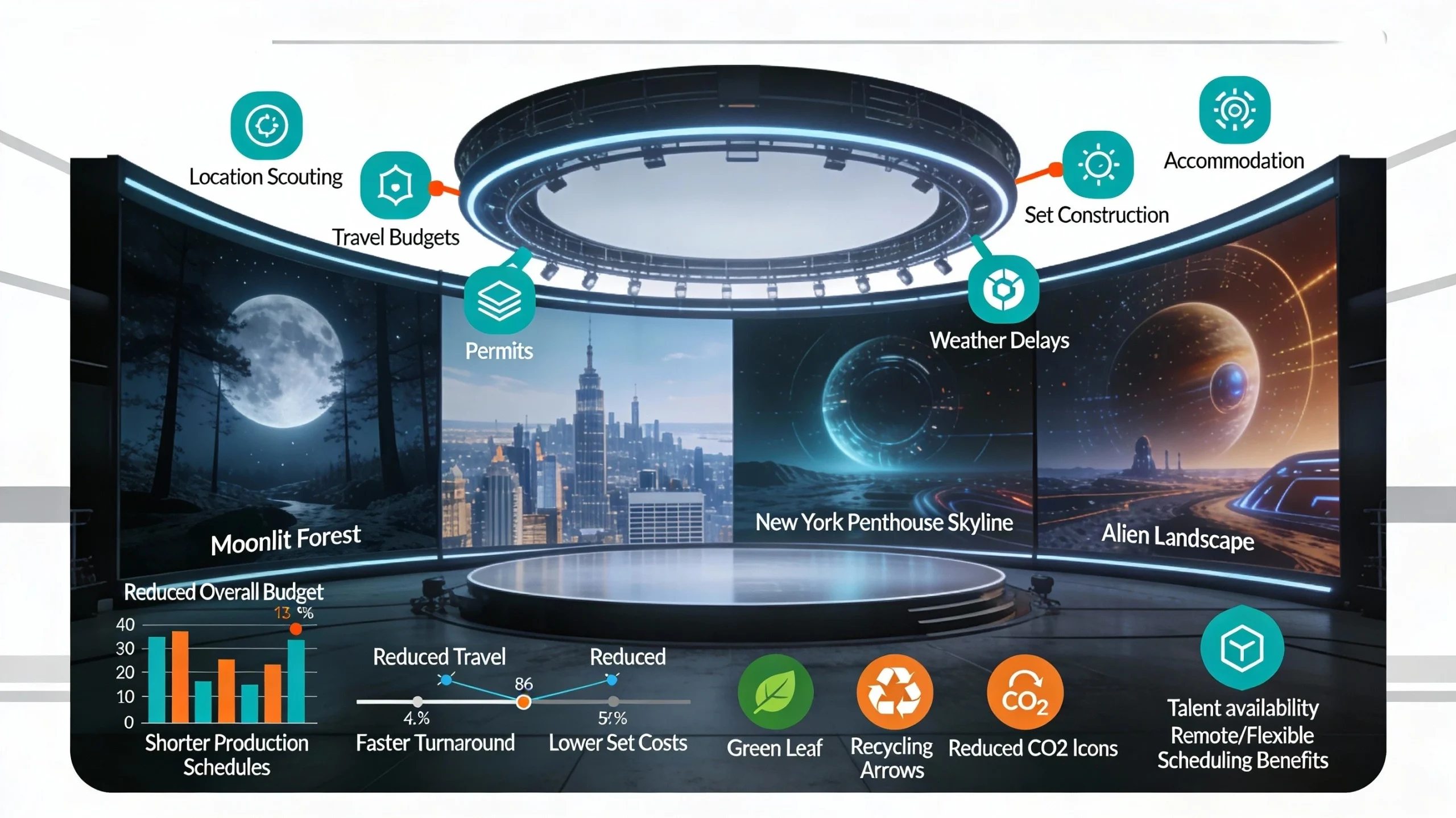
For production professionals, LED volumes eliminate the limitations that have plagued visual effects for decades. No reliance on weather, no location scouting logistics, no travel budgets. A moonlit forest, a New York penthouse, or an alien landscape—all exist within the controlled confines of a studio. The actor’s eyes reflect the environment naturally. Shadows fall correctly. Light bounces realistically. Everything works in-camera.
Why Location-Free Production Matters
Cost Efficiency: Scouting, permits, accommodations, equipment transport—location shoots drain budgets quickly. LED volume studios eliminate these expenses while accelerating production efficiency. A week-long location shoot becomes a controlled studio day. Equipment doesn’t travel. Crews remain based in one location. Insurance, security, and logistics costs plummet. The ROI becomes immediately apparent in budget reconciliation.
Creative Flexibility: Directors can modify environments mid-shoot. A scene shot in daylight can instantly become nighttime. A Victorian mansion can become a sci-fi bunker. Weather changes mid-day? Not a problem. This iterative freedom was impossible with traditional methods, where you shoot what you scouted or reshuffle your schedule.
Talent Availability: Actors no longer travel for weeks. They shoot in consistent comfort, boosting morale and performance quality—critical for ad films and high-stakes commercial work where authentic emotion drives engagement. Top-tier talent becomes accessible without requiring multi-week location commitments. This democratizes access to premium creative talent.
Sustainability: No location impact, no large crews traveling. Studios are increasingly marketing LED volume capabilities as an environmentally conscious choice—resonating with brands that prioritize sustainability narratives.
The Real-Time Advantage Over Green Screens
The magic of LED volumes lies in real-time feedback. Unlike green screen workflows where final compositing happens weeks later, LED volumes show results instantly. A cinematographer adjusts lighting and sees how it interacts with the virtual environment immediately. A director frames a shot knowing exactly how the background will look. This eliminates post-production surprises and reshoots cycles that drain budgets.
This immediate feedback loop is revolutionary for creative storytelling. Creators can experiment, pivot, and refine during production rather than being locked into a pre-determined plan. The director can request three different lighting scenarios and compare them in real-time. An actor can try emotional beats against different environmental contexts. This flexibility compounds creative quality.
The Hybrid Future: LED Volumes + Complementary Techniques
Smart productions combine LED volumes with traditional methods. Wide shots might use digital content integration, while close-ups leverage LED immersion. Outdoor sequences might still use practical locations where they make budget sense, while controlled scenes stay studio-bound. This hybrid approach gives directors options without forcing an all-or-nothing commitment.
The convergence of LED volumes with virtual production represents more than a technology upgrade—it’s a paradigm shift. Studios that embrace these tools gain speed, cost advantages, and creative latitude that traditional location-based work cannot match. The future isn’t about abandoning locations entirely; it’s about choosing strategically where physical environments matter most.
Conclusion: The Competitive Edge
The question isn’t whether LED volumes will replace physical locations—it’s how quickly your production houses can adapt. For studios nationwide, LED volume investment isn’t optional anymore; it’s the foundation of competitive advantage. Whether you’re producing commercial work, feature films, or branded content, the freedom to create anywhere, anytime, is now within reach.
The studios that pioneered this transition didn’t just adopt new technology—they fundamentally reimagined how production workflows function. They discovered that constraints breed creativity, but unnecessary constraints breed frustration. LED volumes remove the unnecessary constraints while maintaining creative standards. For any production house serious about competing in 2025, this technology isn’t the future—it’s the present.
FAQ’S
Q1. What is an LED volume?
An LED volume is a stage surrounded by high-resolution LED screens that display real-time 3D environments, allowing filmmakers to capture finished shots in-camera without post-production compositing.
Q2. How is an LED volume different from a green screen?
LED volumes show the final background live on set, creating realistic in-camera results instantly, while green screens require weeks of post-production compositing and keying work.
Q3. Are LED volumes more cost-effective than location shoots?
Yes, LED volumes eliminate travel, location permits, and extensive post-production costs while delivering faster turnarounds and fewer reshoots.
Q4. Are LED volumes ideal for ad films and branded content?
Yes, LED volumes allow creators to produce multiple high-quality locations in a single day, perfect for fast-turnaround advertising and branded content campaigns.
Q5. Can LED volumes replace physical shooting locations entirely?
While LED volumes work for most controlled indoor shoots, the best productions blend both—using LED volumes for complex setups and real locations where authentic environments matter most.