

AI Avatars vs. Real Actors: Choosing the Right Talent for Your Video Content in 2025
The question isn’t whether AI avatars or real actors are better—it’s when to use each one. In 2025, brands aren’t choosing between AI and live talent; they’re strategically deploying both to dominate their content calendar.
The global AI video generator market is exploding, growing from $614.8 million in 2024 to $716.8 million in 2025, with projections soaring past $2.5 billion by 2032. But this growth doesn’t mean real actors are becoming obsolete. Instead, smart marketers are using AI for rapid iteration and real talent for emotional impact and scaled campaigns.
The Cost Advantage: AI Avatars Win by Thousands
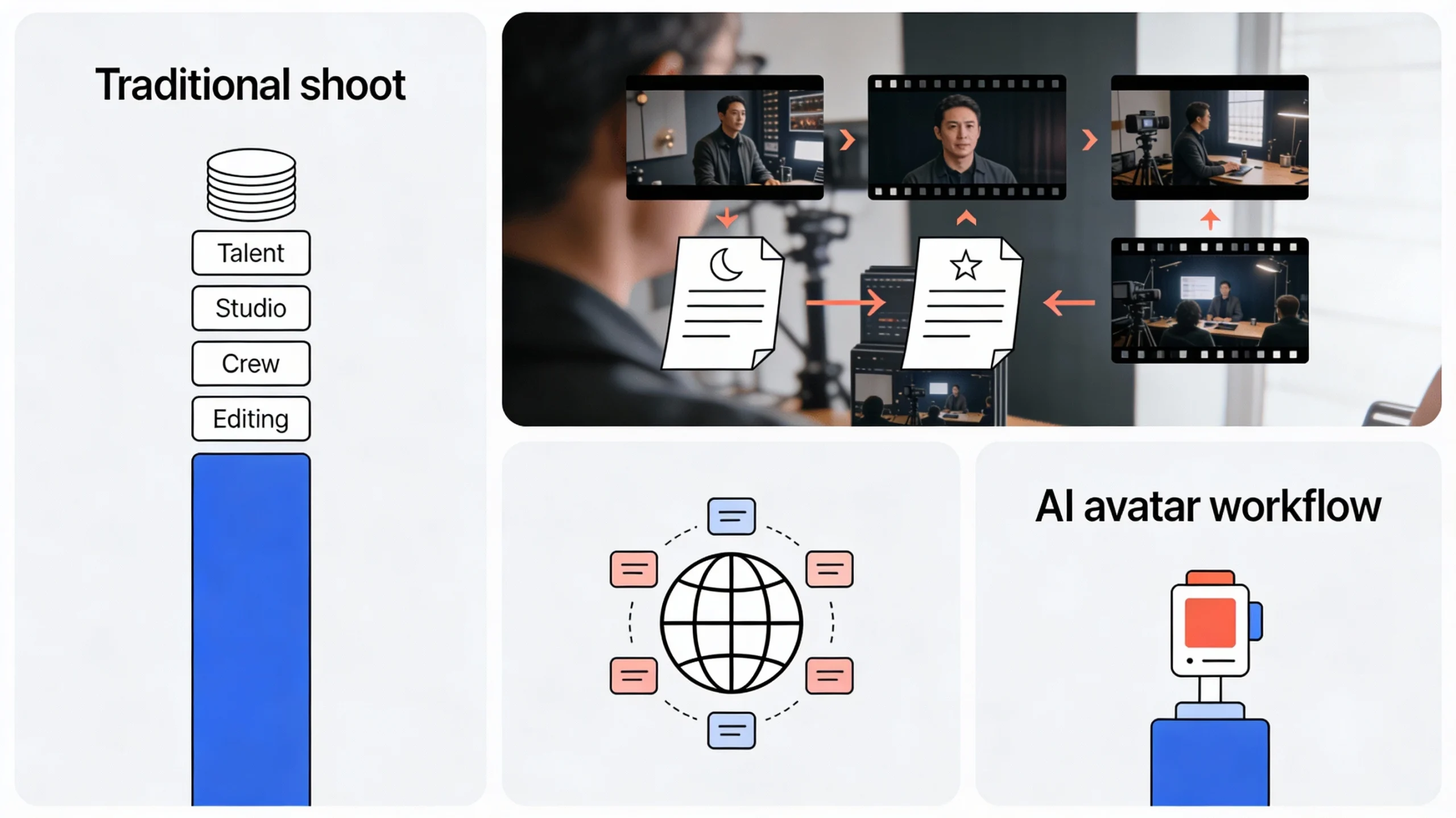
Let’s talk dollars. Traditional video production with real actors involves hiring talent, booking studios, arranging crews, managing logistics, and extensive post-production—easily running $5,000 to $50,000+ per video.
AI avatars eliminate these costs entirely. Once you’ve created your digital avatar (requiring just 15 minutes of on-camera footage), you can produce unlimited videos for a fraction of the price. This makes AI and digital marketing strategies particularly valuable for brands needing to scale content without scaling budgets.
For small businesses and startups, this cost differential is transformative. You can produce professional-quality videos for under $100, which opens doors previously locked behind production budgets.
Advantage: AI Avatars
Timeline: Speed Meets Iteration Power
Real actors require weeks—from auditions and scheduling to filming and editing. Each script revision means reshoots, delays, and additional costs.
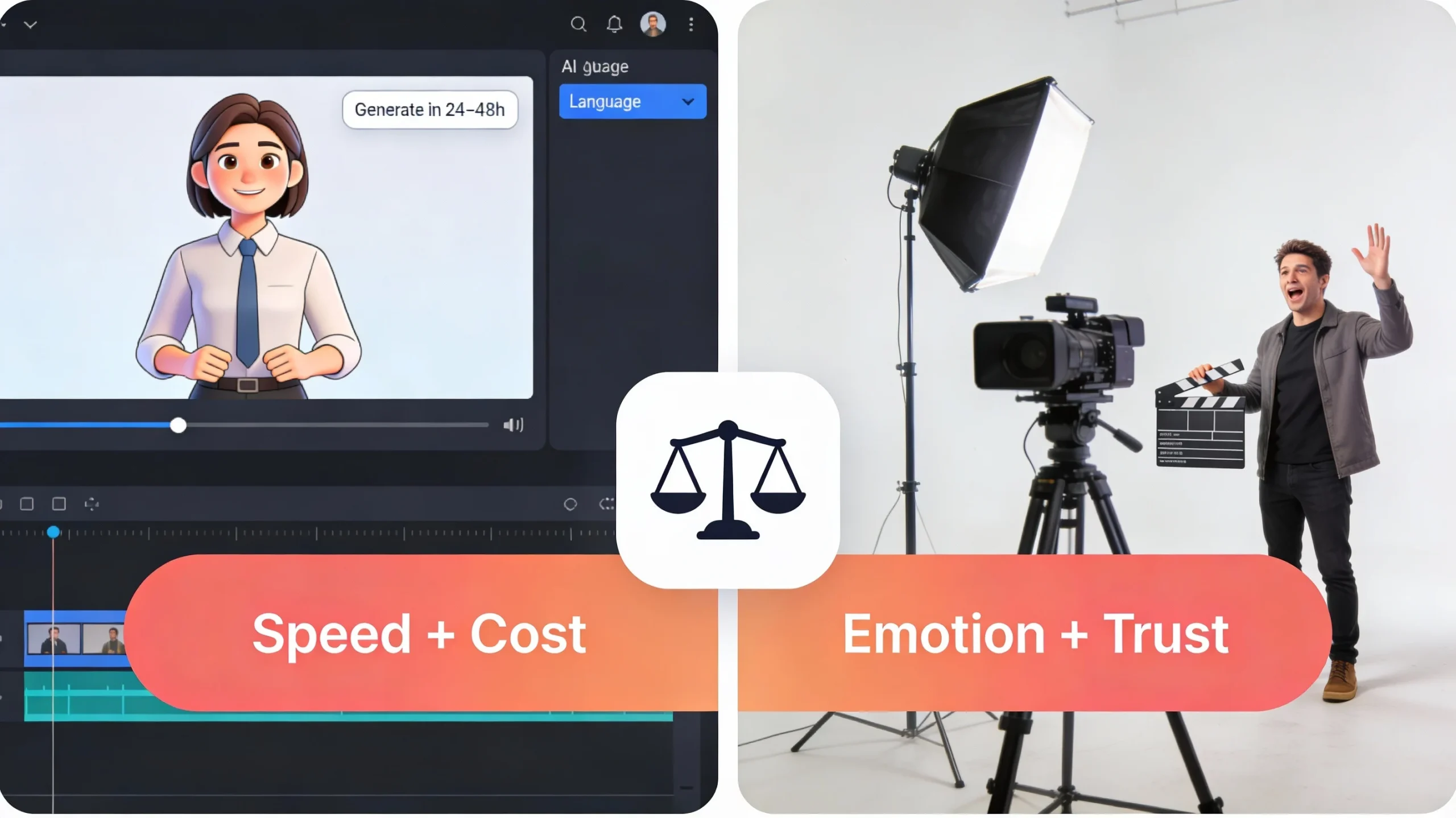
AI avatars flip this equation. Generate a video from your script in 24-48 hours. Need to test three different messaging angles? Create three videos overnight. Found a winning script? Instantly localize it into 10 languages with one-click translation.
This speed enables something powerful: rapid A/B testing. Your marketing team can experiment with hooks, angles, and calls-to-action without waiting for production schedules.
The motion and creative agencies we’ve partnered with have cut their video production cycles from 6-8 weeks to 1-2 days using AI avatars for initial concepts and testing.
Emotional Connection: Real Actors Still Reign
Here’s where real actors pull ahead. Humans naturally respond to authenticity, subtle micro-expressions, genuine emotion, and unpredictable moments. When a real person shares a customer testimonial, struggles with a problem, or celebrates a win—viewers feel it.
AI avatars, despite incredible advancements, still lack this emotional depth. Modern avatars achieve photorealism and natural movement, but voiceover quality can sound robotic, and the spontaneity that builds trust remains elusive.
For brand storytelling, customer testimonials, and emotional narratives, video content creation with real humans is non-negotiable. This is especially critical for high-stakes communications like founder stories, crisis messaging, or deep relationship-building.
Consistency & Brand Control: AI Avatars Lead
Your AI avatar looks and sounds exactly the same in every video. No sick days, no personality changes, no union disputes. This consistency is gold for training videos, customer support interactions, and institutional messaging where uniformity matters.
Real actors bring inconsistency—their mood, energy, or interpretation can shift between shoots. For campaigns requiring pixel-perfect content personalization and brand consistency, AI avatars deliver predictability.
The Winning Strategy: Use Both
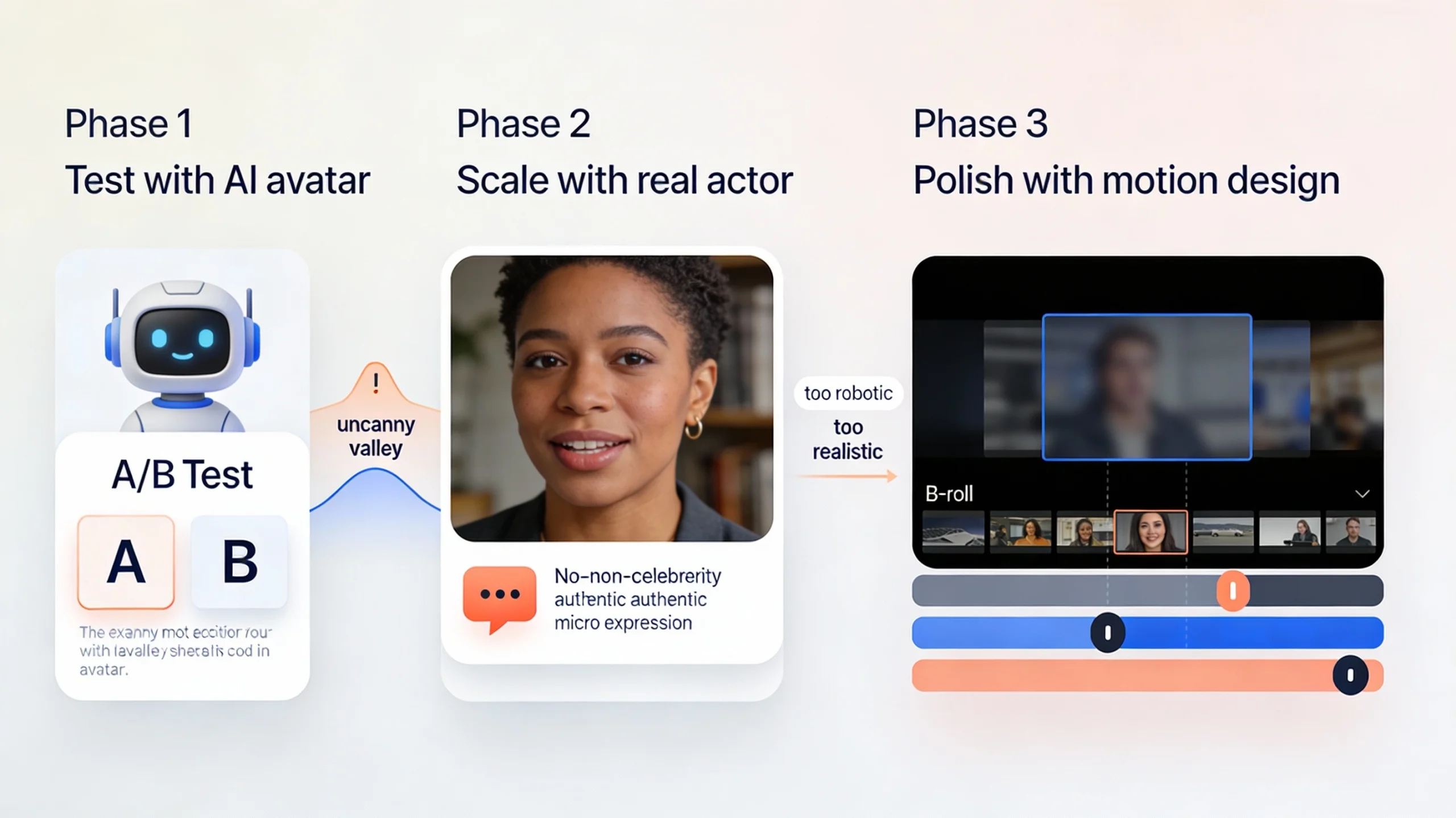
The smartest brands in 2025 aren’t choosing—they’re combining both approaches:
Phase 1: Test with AI Avatars
Use AI avatars to rapidly validate messaging, test script variations, and identify winning concepts. This costs almost nothing and reveals what actually resonates with your audience.
Phase 2: Scale with Real Actors
Once you’ve found a winning script and proven ROI, invest in real actors to elevate the production quality, deepen emotional connection, and build brand authority.
Phase 3: Optimize with Motion Design
Layer both AI and real footage with professional motion graphics, B-roll, product shots, and cutaways to solve the “uncanny valley” issue and create polished, broadcast-quality content.
The Framework for Decision-Making
Use AI Avatars when:
- You’re testing multiple scripts and hooks
- Speed and cost-efficiency matter most
- You need rapid localization across markets
- You’re producing training or educational content
- Budget constraints exist
- You need 24/7 availability (chatbots, support videos)
Use Real Actors when:
- Your message must build deep emotional trust
- You’re investing in brand-level, hero content
- Authenticity is your core differentiator
- You’re already confident in your messaging
- Long-term brand equity is the goal
- Customer testimonials or founder stories are involved
Looking Ahead
The future isn’t AI replacing actors—it’s human creativity accelerated by AI. The teams that test more, iterate faster, and dare to experiment will win. And in 2025’s competitive landscape, speed paired with strategic human connection is your biggest advantage.
At Garage Productions, we’re blending both worlds—deploying AI avatars for rapid iteration and real talent for impact. The result? Faster production, better ROI, and content that actually moves audiences.
FAQ’S
1. How much does an AI avatar video cost?
$50–$300 per video (plus any tool subscription).
2. Can AI avatars replace real actors?
Not fully—avatars scale fast, actors build emotion and trust.
3. Which is faster: AI avatars or real shoots?
AI: 24–48 hours; real shoots: a few weeks.
4. What’s the biggest drawback of AI avatars?
They can feel less natural or emotionally convincing.
5. What should I choose for my first campaign?
Test with AI first, then use real actors for the best-performing idea.