

Micro-Drama Brand Integrations: How Indian Companies Are Funding & Starring in Viral Series
Indian brands are no longer buying ad slots inside micro-dramas—they are writing themselves into the story. From boAt integrating into Gen Z youth narratives to Myntra launching a six-episode wedding season series, Indian companies are funding, co-creating, and literally starring in micro-drama IP that drives brand recall far beyond what traditional advertising achieves. With India’s micro-drama market racing toward ₹4,000 crore by 2026 at 40-50% year-over-year growth, brand co-productions have transformed from experimental budgets into core marketing strategies.
Why Indian Brands Are Moving Inside the Story
The economics of attention have fundamentally shifted. Micro-dramas deliver distraction-free mobile viewing environments where branded content commands 30-50% higher CPM rates than standard influencer sponsorships precisely because the narrative removes the psychological wall between content and commerce. “The format favours sharper storytelling over louder storytelling, making every moment emotional,” explains a senior creative director at a leading agency—”the integration opportunity is especially powerful because the story lets brands act like characters and shape the narrative without selling”. 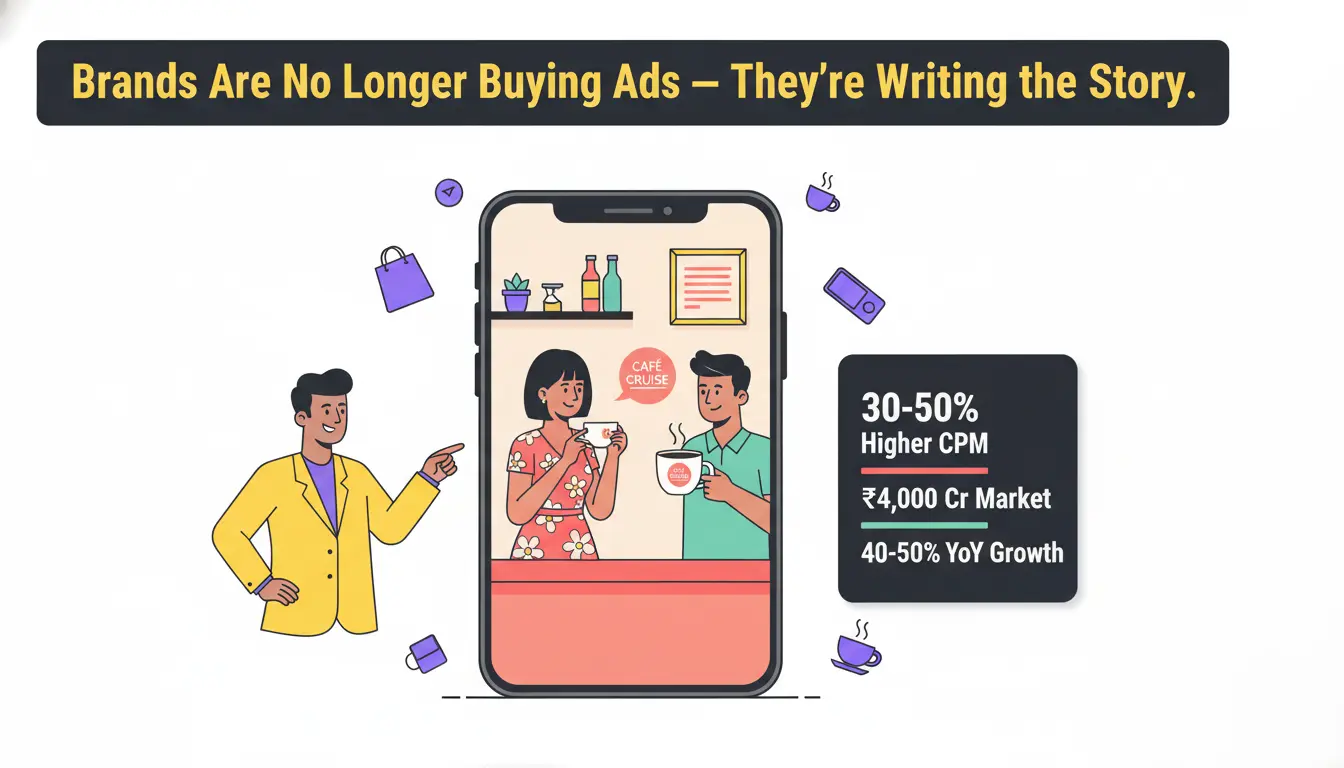
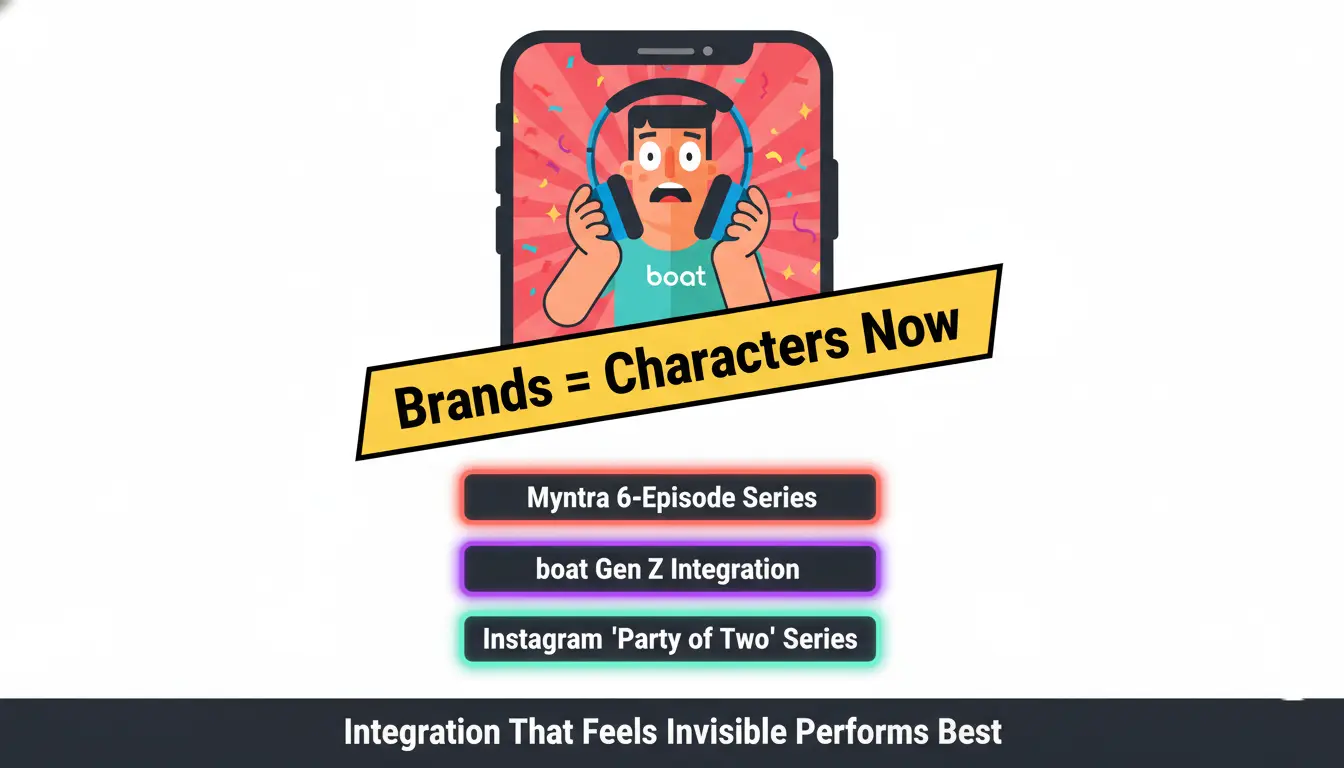
This character-level integration generates superior recall because audiences experience the brand as part of a story they chose to watch rather than an interruption they tolerate. boAt’s VP of Media confirms the appeal directly: “If the narrative matches our vibe—fun, energetic, and rooted in youth culture—micro-dramas could be a fantastic way for us to deepen our connection with Gen Z and millennials”. For production houses deploying viral casting strategies that prioritize relatable faces over celebrities, this brand integration feels authentic rather than transactional.
Real Indian Brands Already Inside Micro-Dramas
Myntra launched a six-episode micro-drama series starring digital creators to capture wedding season traffic, showcasing affordable fashion for every occasion—mehendi to reception—within storylines where outfit choices drove character decisions naturally. The series performed significantly better than equivalent paid media spend by generating organic sharing, creator fan engagement, and repeat views that standalone advertisements cannot replicate.
Instagram India produced “Party of Two,” a micro-drama series designed explicitly to engage Gen Z while subtly reinforcing Instagram’s positioning as the definitive platform for creative storytelling. By owning the format rather than advertising inside it, Instagram converted passive viewers into active creators—generating platform behavior change alongside brand awareness.
Zupee Studio, the gaming company’s micro-drama platform, launched comedy, crime, and romance series targeting small-town audiences in Hindi—directly integrating its gaming identity into entertainment formats that serve overlapping user demographics. The hybrid model of gaming company meets content studio exemplifies how Indian companies are building micro-drama IP as core business infrastructure rather than marketing add-ons.
MX Fatafat, Amazon’s MX Player micro-drama offering, entered the space with platform-funded series reflecting Amazon’s broader push to own short-form content distribution in India. With Amazon, JioStar, and Zee simultaneously exploring micro-drama investments, platform competition is accelerating branded content deals as each ecosystem bids for exclusive IP.
The Three Integration Models Indian Brands Use
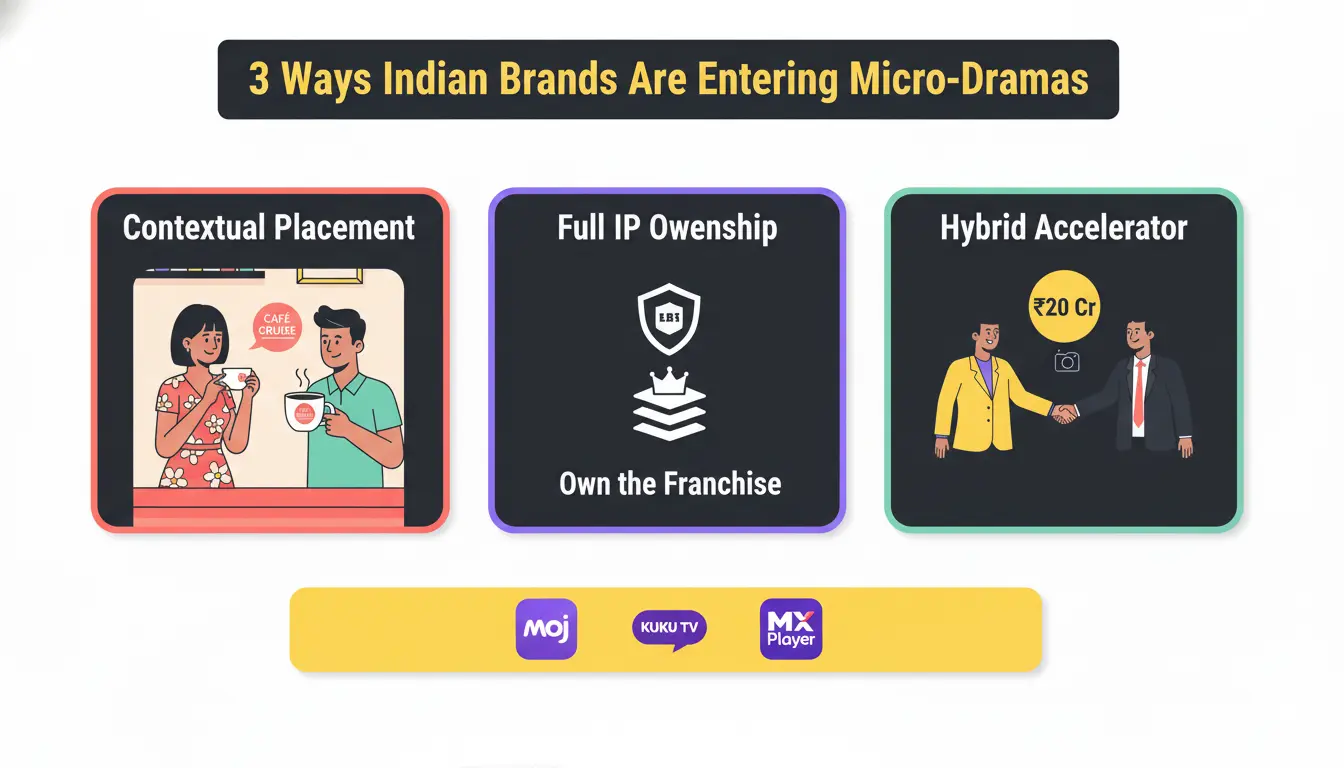
Contextual Product Placement: Products appear as natural plot devices rather than inserted advertisements—a character’s confidence transformation begins with a skincare purchase, a romantic gesture involves a gifted gadget, or a friendship bond forms around sharing a branded snack. Kuku TV’s platform leverages gamification through “Bullet Coins,” where users engage with advertiser-sponsored content or unlock episodes via brand interactions, making advertising part of the entertainment architecture itself.
Full IP Ownership: Brands commission entire series retaining all intellectual property rights, controlling character development, storyline direction, and distribution strategy while production houses execute creative vision. This model suits established brands with strong digital infrastructure who want to own audience relationships rather than renting attention from platform algorithms—enabling franchise building through sequels and spin-offs without renegotiating rights.
Hybrid Accelerator Partnerships: Moj committed ₹20 crore annually to its Micro Drama Challenge accelerator, connecting creators, filmmakers, and production houses with brand funding opportunities through structured co-development programs. These platform-mediated partnerships reduce friction for brands entering micro-drama by providing production infrastructure, audience distribution, and performance measurement within unified ecosystems.
The Dabur-Rajiv Dubey Framework for D2C Advantage
Dabur India’s VP & Head of Media, Rajiv Dubey, articulated the strategic imperative clearly: “Micro-drama partnerships represent not just an innovative marketing tactic but an essential move to remain culturally relevant and meaningfully connected with India’s next generation of consumers”. This D2C-first mindset explains why beauty, fashion, food, and quick commerce brands lead adoption—they operate with entertainment-style production logic, short decision cycles, and audiences who consume content and commerce through identical mobile interfaces.
Forward-thinking D2C brands recognize that regional language integration multiplies this advantage exponentially—a brand appearing authentically in Bhojpuri, Tamil, or Bengali micro-dramas builds cultural credibility impossible through dubbed Hindi advertising. MiniPix’s ₹2.4 crore pre-seed raise specifically to scale Bhojpuri micro-dramas signals investor confidence that vernacular brand integration unlocks Tier-2/3 purchasing power previously inaccessible to digital-native brands.
Why FMCG Giants Are Still Watching—And When They’ll Move
India’s largest FMCG advertisers maintain cautious positions rooted in measurement challenges rather than creative skepticism. “Standard FMCG ROI models prioritise metrics like attribution, cost-per-reach, or sales, which are harder to measure with micro-dramas,” explains brand consultant Nisha Sampath. Unlike a standard campaign with predictable reach metrics, micro-dramas require commitment across multiple episodes before understanding whether stories work—an uncertainty that clashes with quarterly performance expectations.
The talent and ecosystem gap compounds this hesitation—writers, directors, and producers comfortable with the format’s specific demands remain scarce compared to conventional advertising talent pools. However, industry observers predict significant shifts: “It is still early days and we should expect significant adoption by big advertisers in the coming months,” notes one senior industry analyst. As platforms build measurement tools tracking completion rates, brand lift scores, and attributable sales, FMCG reticence will dissolve into competitive urgency.
Investment Flooding India’s Micro-Drama Ecosystem
The capital flowing into India’s micro-drama infrastructure signals irreversible mainstream adoption. Flick TV raised $2.3 million from Stellaris Venture Partners, Gemba Capital, and Titan Capital to produce 100+ original titles across premium genres. Chai Shots (Telugu), Viralo (Hindi), ReelSaga, Eloelo, and Dashverse collectively raised $44-48 million through seed rounds in 2025 alone. By 2026, 600-650 million Indians are expected to consume short-form video, positioning the category as an $8-12 billion market by 2030.
This investment creates self-reinforcing infrastructure: better-funded platforms attract superior production talent, enabling higher-quality branded content, attracting larger brand investments, generating platform revenue that funds next-generation content. Production houses that establish brand integration expertise now will command premium positioning as this flywheel accelerates, particularly those offering end-to-end solutions from hook-optimized scripting through multilingual distribution.
The Skoda Principle: Audience Precision Over Mass Reach
Skoda’s approach crystallizes the strategic intelligence separating successful micro-drama integrations from experimental budget burns: “Their buyers aren’t in remote villages watching television but on digital platforms consuming mobile-first content, making micro-drama co-productions logical budget allocations”. This audience precision logic applies across premium categories—luxury brands, automotive, financial services, and technology companies whose customers actively consume short-form video content on the exact platforms distributing micro-dramas.
The same logic applies to production strategy: a brand whose customer is urban, aspirational, and mobile-first should prioritize 3-second hook optimization over reach metrics, creating content that earns attention through storytelling quality rather than buying impressions through media planning. This philosophical shift—from interruption to invitation—defines the difference between brands that successfully integrate into micro-drama culture and those that simply place logos in someone else’s story.
Making Integration Feel Invisible
The highest-performing brand integrations share one characteristic: viewers finish episodes remembering the story first and the brand second, yet associate both with identical emotional registers. A 60-second story of two roommates arguing over dal chawal can create brand awareness through cultural specificity that a 30-second product demonstration never achieves. “Micro-dramas mimic real-life moments,” and brands that inhabit those moments authentically generate the parasocial connection that drives purchase behavior without triggering advertising resistance.
Sound design plays a critical role in this invisibility—brand audio logos, product interaction sounds, and music choices that reinforce emotional associations work subconsciously, building brand identity through sensory experience rather than explicit messaging. The most sophisticated Indian brand integrations deploy these techniques deliberately, treating audio architecture with the same strategic rigor applied to visual identity.
Building Your Brand Integration Strategy
Start with a single micro-drama series testing one specific integration model before committing to franchise-level investment. Choose production partners who understand both storytelling craft and brand objectives—the intersection of these competencies determines whether integration feels organic or forced. Commit to a minimum of 15-20 episodes before evaluating performance, as individual episode metrics reveal nothing about the serialized engagement patterns that drive brand equity.
Define success metrics beyond traditional advertising KPIs: track completion rates revealing story investment, next-episode clicks indicating franchise potential, shoppable conversion rates connecting narratives to commerce, and organic sharing velocity measuring cultural resonance. These metrics tell brand stories that impression counts cannot, providing evidence for scaling investment when results demonstrate the format’s superior engagement economics.
India’s most culturally resonant brands in 2026 will not be those spending the most on micro-drama advertising—they will be those that became the most compelling characters in stories their audiences actually chose to watch.
FAQ’S
Q1: Which Indian brands are already successfully integrating into micro-dramas?
Myntra, boAt, Instagram India, Amazon MX Fatafat, and Zupee Studio have all launched branded micro-drama integrations with measurable engagement outcomes in 2025-2026.
Q2: How much does a brand micro-drama integration cost in India?
Production budgets range ₹10-50 lakh per complete series, with brand integration fees varying by platform exclusivity, episode count, and whether brands seek co-production rights or placement-only deals.
Q3: Why are FMCG brands hesitant about micro-drama integration despite audience growth?
Traditional ROI models measuring attribution, cost-per-reach, and sales struggle with micro-drama’s serialized engagement patterns—brands need multi-episode commitment before performance becomes measurable.
Q4: What makes brand integration in micro-dramas more effective than advertising?
Contextual product placement within emotionally resonant storylines removes advertising resistance, generating 30-50% higher CPM rates while creating cultural associations impossible through interruptive ad formats.
Q5: How should brands measure ROI from micro-drama integrations?
Track completion rates, next-episode clicks, organic sharing velocity, brand lift scores, and shoppable conversion rates rather than traditional impression metrics or CPM calculations.