

Build Addictive 60-Second Micro-Education Video Lessons To Hook Audiences Instantly
Educational content is exploding. LinkedIn reports 34% growth in educational video consumption. YouTube’s Learning channel reaches 2 billion viewers. TikTok’s educational content generation surpasses entertainment.
But here’s what separates viral educational content from forgotten uploads: addiction mechanics.
Most educational videos treat learning as passive consumption. Watch, absorb, move on. The ones generating millions of views—and building loyal student communities—architect lessons using addiction psychology.
At production houses in Noida creating educational content for clients, understanding this distinction multiplies your project value 5-10x.
The 60-Second Educational Format: Why It Works
Sixty seconds is the sweet spot for education:
- Long enough to teach actual concepts (not just teases)
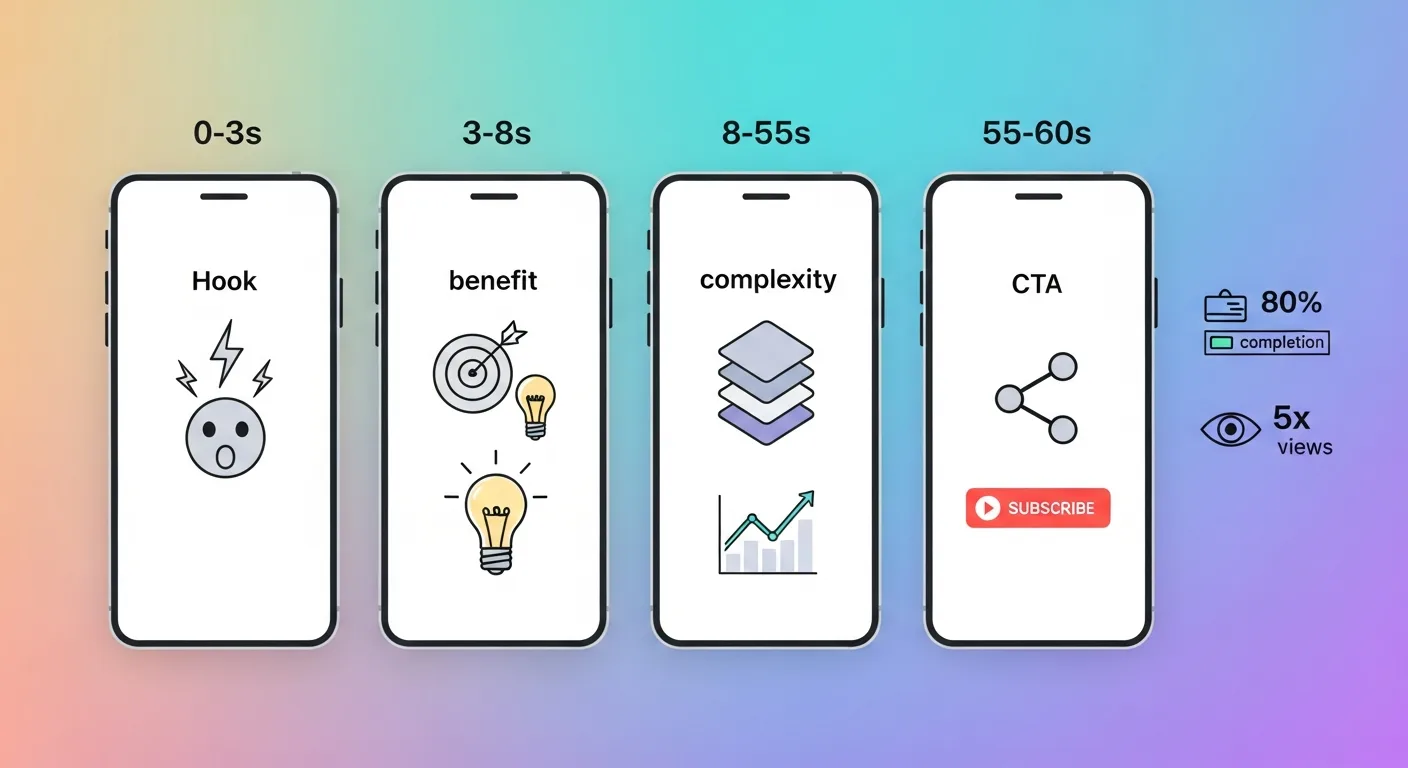
- Short enough to sustain attention (completion rates above 80%)
- Replay able (viewers re-watch to solidify learning)
- Shareable (students forward to peers: “this explains it perfectly”)
This format thrives across platforms. TikTok algorithms favor 45-90 second videos. YouTube Shorts rewards 30-60 second content. LinkedIn professionals consume 40-80 second posts consistently.
Yet most educators waste this format. They frontload information—dumping explanation into the first 30 seconds, then padding with examples. By second 45, viewers have mentally checked out.
The Addiction Architecture: Four Elements
Element 1: The Pattern Interrupt Hook (0-3 seconds)
Educational videos fail when they start with preamble. “Today we’re learning about…” causes 60% immediate scroll-away.
Addictive lessons open with cognitive conflict: a statement contradicting student assumptions.
Example architecture:
- “Wrong: You’ve been calculating ROI incorrectly”
- “Everyone makes this money mistake”
- “This 10-second trick solves the problem you face daily”
This pattern interrupt triggers curiosity. The brain asks: “What’s wrong with my approach?” Now you have attention.
Understanding the psychology of micro-drama hooks applies directly to educational content. Unexpectedness drives engagement across all content types.
Element 2: Benefit Promise (3-8 seconds)
After the hook, viewers need to understand what they’ll learn and why it matters.
“In 60 seconds, you’ll learn the framework Wall Street analysts use to predict stock movement.”
This isn’t manipulation. It’s clarity. Students deciding whether to invest attention need immediate understanding of ROI.
Element 3: Progressive Complexity (8-55 seconds)
The lesson itself must layer information systematically:
Seconds 8-15: Introduce single core concept with visual proof (diagram, animation, example)
Seconds 15-35: Expand with 2-3 specific applications or details
Seconds 35-50: Provide actionable takeaway student can implement immediately
Seconds 50-55: Tease advanced concept to drive series completion
This progression prevents cognitive overload while creating cliffhanger momentum.
When mastering short-form video production techniques, educational content demands tighter pacing than entertainment. Every second must advance learning or maintain engagement.
Element 4: Call-to-Action Triggers (55-60 seconds)
The final 5 seconds determine whether viewers:
- Watch the next lesson (series completion)
- Share with peers (organic distribution)
- Subscribe (recurring audience)
Most educators waste this window with generic CTAs. “Like and subscribe” underperforms dramatically.
Addictive educational content uses:
- Series curiosity: “Tomorrow we cover the advanced version”
- Community connection: “Comment your biggest mistake”
- Identity affirmation: “Smart learners always [action]”
These psychological triggers activate social motivation, not algorithmic obligation.
Production Strategy for Micro-Education at Scale
Smart production houses batch-create educational series:
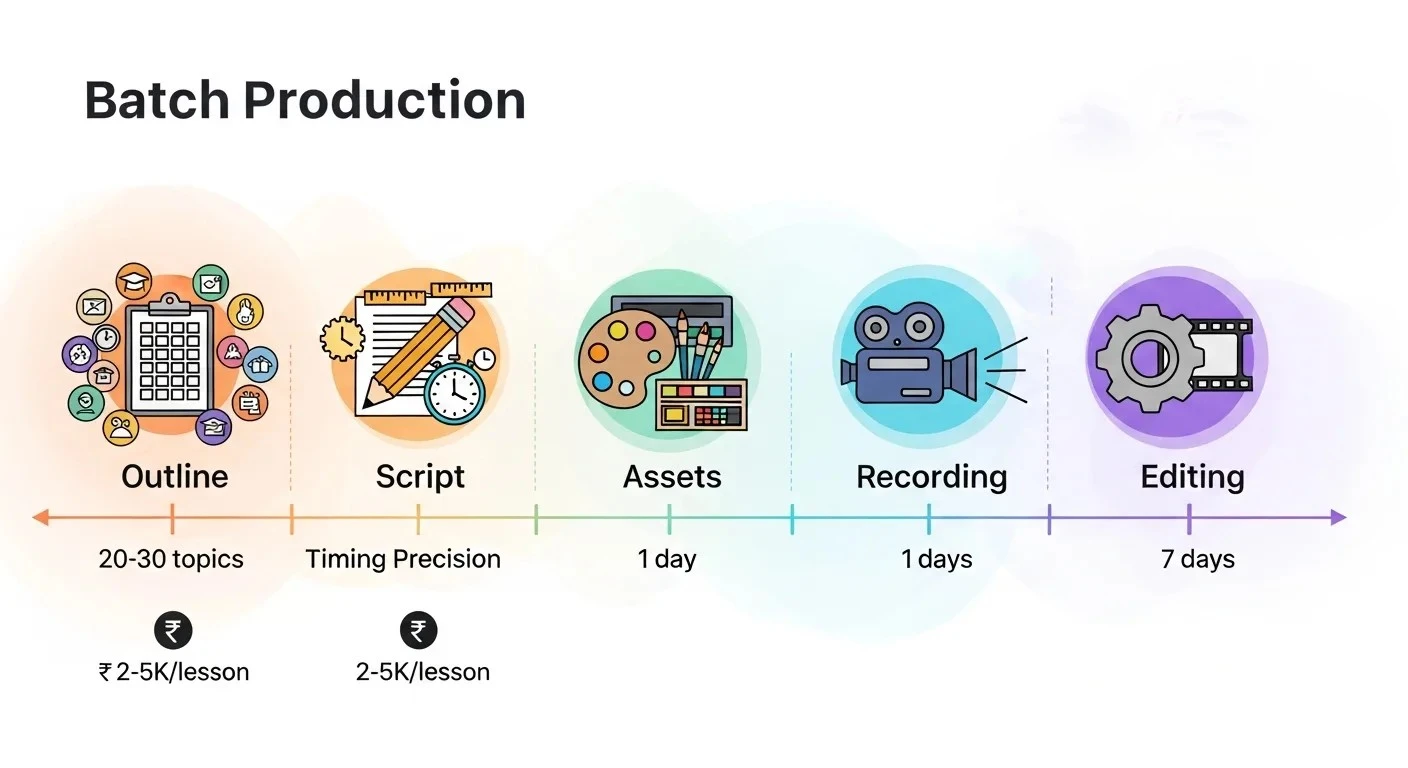
Workflow:
- Content outline: 20-30 lesson topics mapped (2 days)
- Script production: All 20 lessons scripted with timing precision (3 days)
- Visual asset creation: Graphics, animations, B-roll designed (5 days)
- Bulk recording: All 20 lessons recorded (1 day)
- Editing & optimization: Each lesson fine-tuned for pacing (7 days)
This batching reduces per-lesson production cost to ₹2-5K while maintaining premium quality.
When you understand multi-platform distribution strategy and release cadence, educational series become distribution goldmines. One 60-second lesson generates:
- 4-5 TikTok clips (15-20 second extractions)
- 1-2 Instagram Reels (adapted pacing)
- 1 LinkedIn post (professional framing)
- 1 YouTube Shorts version
Each distribution multiplies organic reach.
Retention Mechanics: Why Audiences Keep Coming Back
The production psychology of addictive education:
Cliffhanger pacing: Each lesson ends with unresolved tension driving series continuation.
Progressive difficulty: Lesson 1 (basic), Lesson 5 (intermediate), Lesson 10 (advanced) creates skill-building narrative.
Community participation: Comments and peer interaction create social investment.
Variable rewards: Unpredictable lesson depth (some quick tips, some detailed frameworks) maintains novelty Sound design for educational content amplifies retention. Music builds momentum during examples; silence creates anticipatory pauses before payoffs.
Conclusion
Addictive 60-second educational lessons aren’t flukes. They’re engineered using cognitive psychology, pacing precision, and production discipline.
Production houses mastering micro-education positioning transition from service providers to thought leadership platforms. Educational content builds authority, attracts loyal audiences, and creates recurring revenue through sponsorships and premium tiers.
The education market exploding in 2026 favors production partners understanding addiction mechanics.
FAQ’S
Q1: What’s the ideal length for educational videos?
45-90 seconds sustains attention while allowing substantive teaching. 60 seconds is the sweet spot—long enough for concepts, short enough for completion.
Q2: Should educational videos use music or stay silent?
Music accelerates pacing and emotional engagement. Use music during examples and transitions; silence before reveals creates anticipatory power.
Q3: How many lessons should educational series contain?
Minimum 10 lessons creates perceived value. 20-50 lessons builds habit formation. Beginner series should cap at 15-20 to avoid overwhelm.
Q4: What production equipment is required for micro-education?
Phone camera + ring light + lavalier microphone (₹8-15K total) suffices. AI editing tools handle pacing optimization, captions, graphics.
Q5: How do micro-education videos generate revenue?
Sponsorships (₹20-50K per series), premium tiers (₹99-299 subscriptions), affiliate marketing (courses, tools), or licensing to EdTech platforms.