

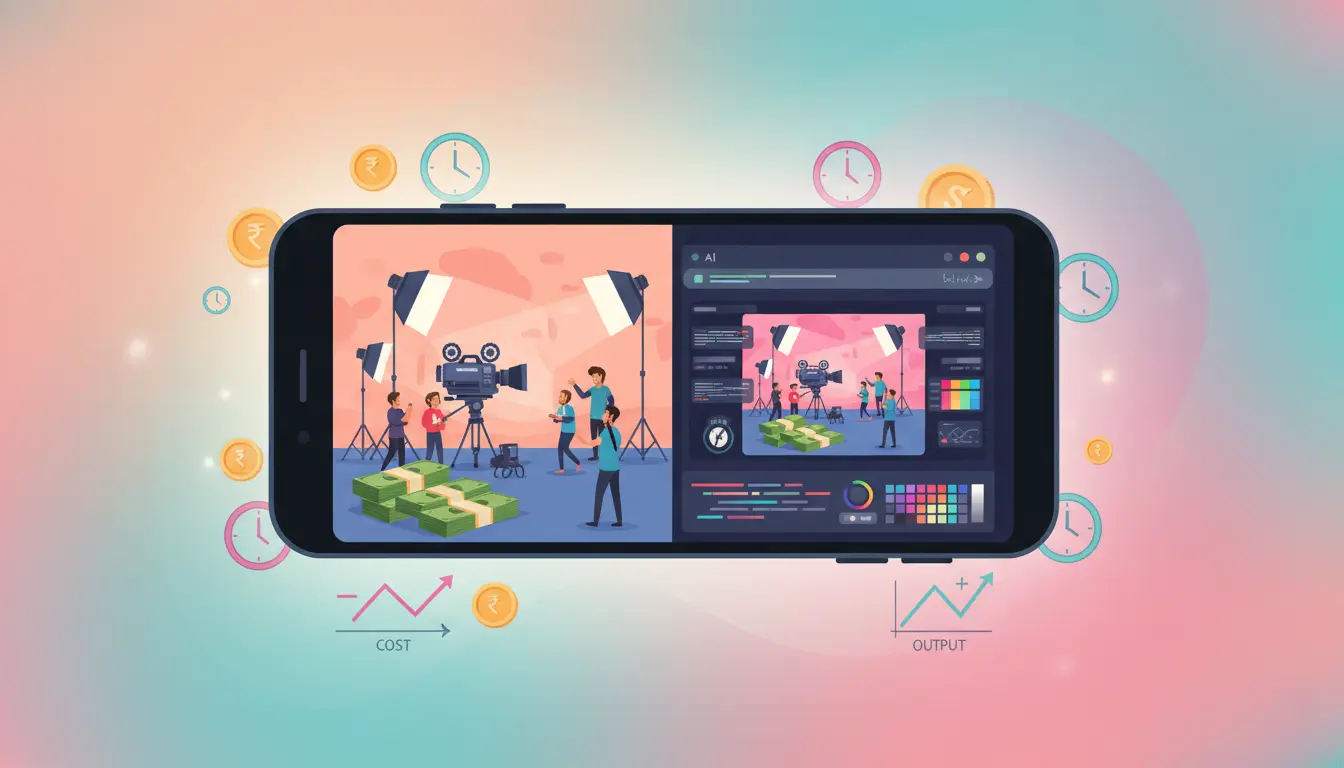
AI-Powered Storytelling: How To Produce A 100-Episode Series On A Micro-Budget
The day traditional production models became obsolete in India was October 25, 2025. That’s when JioHotstar launched Mahabharat: Ek Dharmayudh, a 100-episode AI-animated series that shattered every convention about what constitutes epic-scale production. On its first day, the series logged 6.5 million video views and has since crossed 26.5 million views.
What made it remarkable was simple: no traditional human actors, no physical sets, and cost savings in the range of 50–80%. This is no longer theoretical; AI-powered storytelling is reshaping production economics in real time.
For creators, production houses, and studios wrestling with budget constraints, the question is no longer “Can we afford to produce a 100-episode series?” but rather “How do we leverage AI to produce it profitably?”
The Economics: 75% Cost Reduction
Traditional micro-drama production in India follows a brutal economic equation. A typical 90-minute serialized drama costs ₹40–50 lakh (approximately $4,800–6,000 USD in reported cases) and takes 5–10 weeks from script to screen.
Then came Dashverse, an AI-native platform that cracked the code. Using its proprietary Frameo AI tool, it compresses those economics dramatically: ₹10–12 lakh ($1,200–1,500 USD) and under 3 weeks for a similar 90-minute microdrama—roughly a 75% cost reduction and a 66% timeline compression.
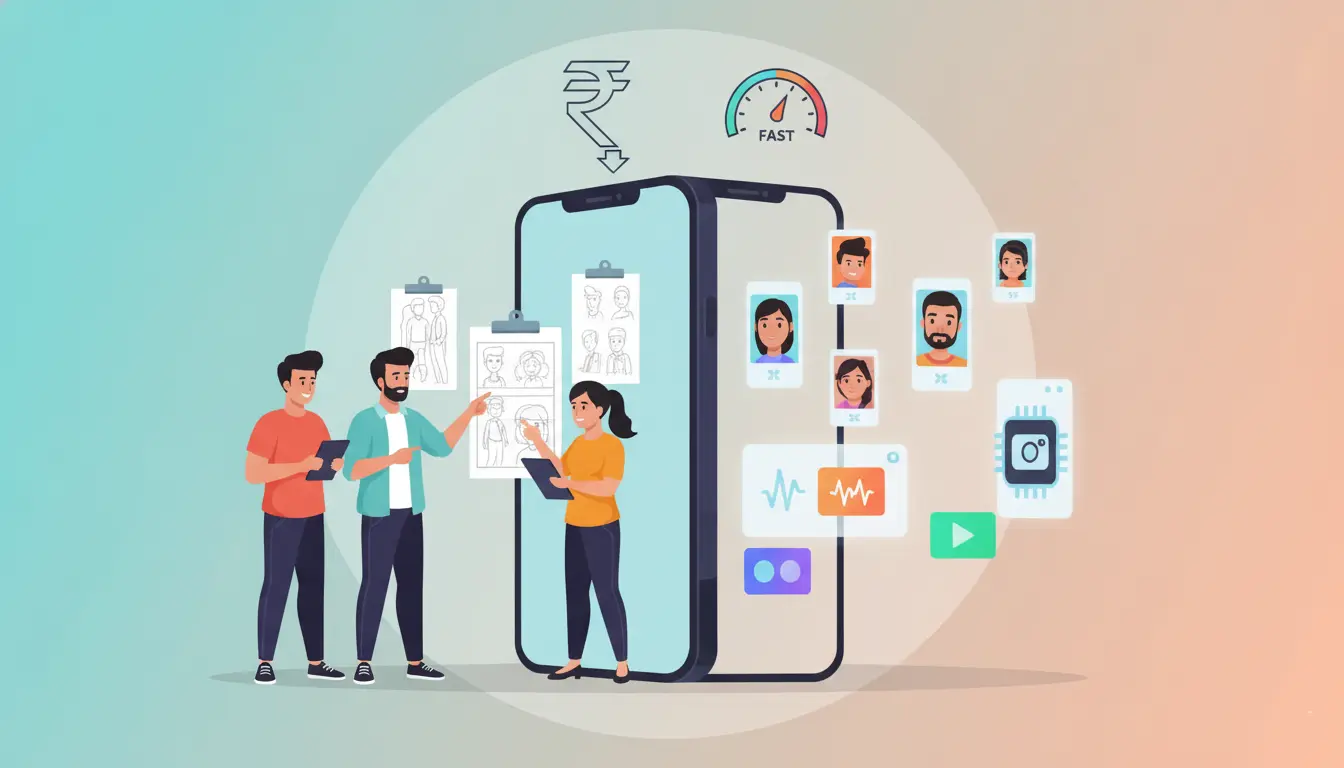
To contextualize: traditional corporate or branded video production often ranges around $100–149 per finished minute or hour, while AI platforms can bring this down to roughly $0.50–$30 per minute depending on the tool and quality targets. Even at the premium end with tools like Google’s Veo 2 at around $30 per minute, you are looking at about $1,800 per hour—still roughly 75% cheaper than traditional workflows.
Dashverse’s results are not an outlier but a proof point that AI-powered video production has fundamentally altered the cost structure of serialized content. The platform is scaling aggressively: it is rolling out dozens of exclusive titles every month, with AI microdramas projected to constitute more than 50% of its revenue by year-end.
The Workflow: 100 Episodes, Zero Sets
How does an AI-first studio actually produce a full series without physical sets or actors? The answer lies in a tightly defined production pipeline. When exploring the rise of vertical cinema and mobile-first narratives, format optimization becomes a force multiplier for this workflow. QuickTV’s AI-generated mythology series Dev Ya Manav illustrates this clearly: a fully AI-generated drama with no human actors and no physical locations in the final output.
Stage 1: Scripting & Character Development
The process begins identically to traditional production: develop the synopsis, craft the narrative arc, and write the scripts. The divergence appears immediately afterward—rather than casting real actors, the team generates AI characters through iterative visual sketching and refinement.
QuickTV’s team used multiple tools: character designs generated via AI image models and then refined using Midjourney to achieve consistent Indian aesthetics. Each character was labeled (for example, “Ashwin,” “Angira”) to prevent AI “hallucination” and to maintain visual consistency across 100 episodes. This is where understanding micro-drama as digital storytelling becomes essential; serialized narratives demand character consistency, and AI requires explicit parameters to deliver it.
Stage 2: Environment & Asset Generation
Entire locations—heavenly palaces, ancient temples, and large-scale battlefields—are visualized through AI-generated environments. Costume references are created using Midjourney across both earthly and heavenly settings, with scene numbers embedded directly in prompts to preserve visual continuity across shots and episodes.
This stage would normally consume weeks of production design, location scouting, and set construction. In an AI workflow, it is parameterized into prompt engineering, reference management, and style-locking instead of physical builds.
Stage 3: Voice & Dialogue Production
Dialogue is crafted and then brought to life using tools like ElevenLabs, which enable character-specific voice generation and modulation. Instead of hiring multiple voice actors, teams create synthetic voices trained on character profiles, tonal guidelines, and emotional references.
This step alone can cost hundreds or thousands of dollars per finished minute in traditional dubbing pipelines; AI can reduce that to a fraction—often under $200 per finished minute for high-quality multilingual output.
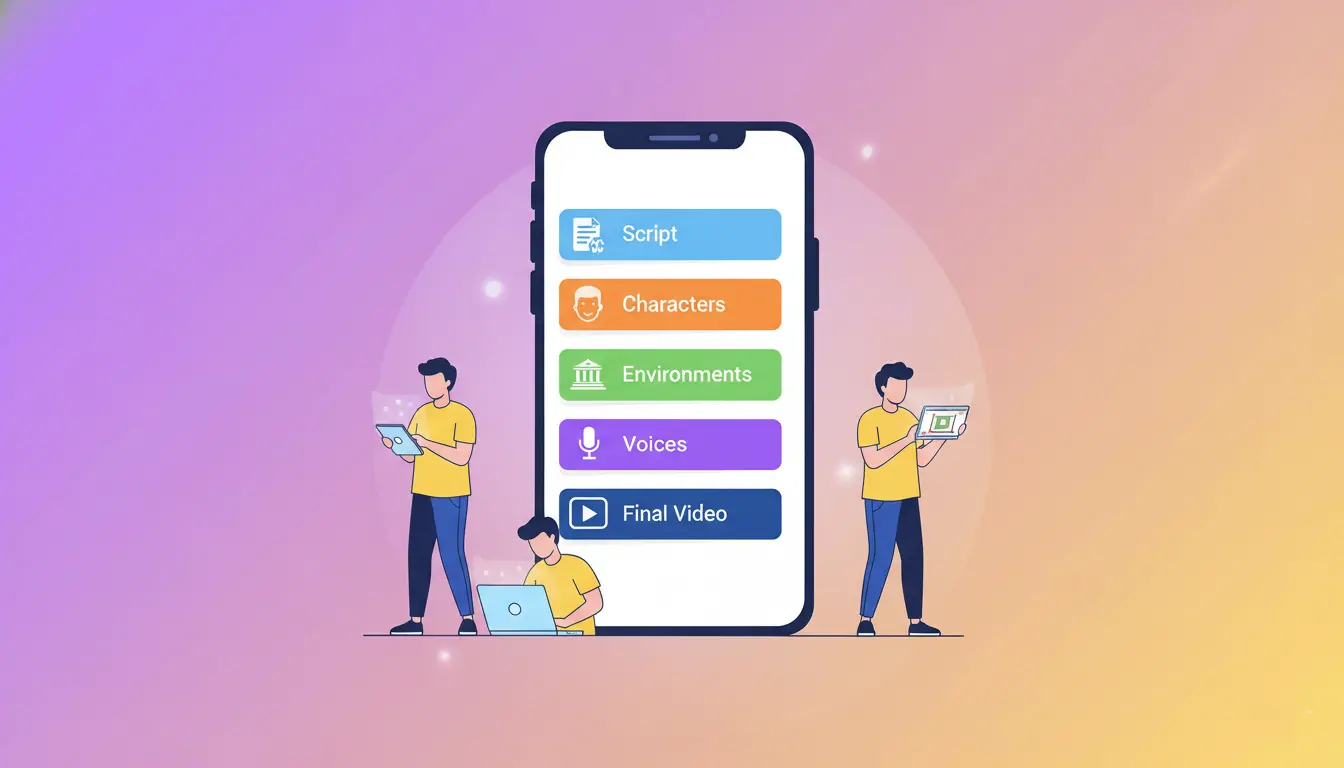
Stage 4: AI Video Generation
Each scene is broken into granular shots with detailed prompts specifying visuals, actions, framing, and lipsync. A typical prompt might read: “Angira in a red sari, walking down the stairs, vertical frame, medium shot, lipsync to dialogue line X.” Reference frames from Midjourney are integrated to anchor style and character continuity.
Optimization principles from short-form video and vertical cinema become critical here. Shots are designed for vertical framing, fast-paced edits, and mobile-first pacing, which further reduces wastage and accelerates production cycles. Turnaround time for experienced teams can be half that of a comparable live-action shoot.
Stage 5: Post-Production & Finishing
Sound design, background scores, SFX, and color grading complete the pipeline. AI-powered tools can generate music, ambient beds, and impact sounds at scale, while auto-mix and auto-master features speed up finishing.
However, human creativity typically steps in here to refine emotional resonance, adjust dynamics, and ensure cultural and tonal alignment.
For experienced teams using optimized workflows, the result is striking: a complete, broadcast-quality episode can move from concept to export in under 15 minutes per finished minute of content, turning production into an almost real-time pipeline.
Reality Check: Strengths and Limits of AI
JioHotstar’s 26.5-million-view Mahabharat success did not escape criticism. Many viewers and critics pointed out a key limitation: emotional depth and human nuance. The visuals are spectacular and technically impressive, but subtle emotional cues—micro-expressions, lived-in body language—are still hard for current AI systems to replicate consistently.
The emerging industry consensus is clear: AI works best as an amplifier, not a replacement. In advertising and long-form storytelling alike, emotional resonance remains non-negotiable for impact. One production expert summarized it: humans bring intuition, cultural understanding, and emotional intelligence, while AI brings speed, scale, and data-driven insight—together they create authentic, efficiently produced content.
This implies that the optimal workflow is not purely AI-generated. Scripts remain human-written (often with AI assistance for drafting and ideation), and emotional direction, character intent, and cultural nuance come from creators. AI handles execution at scale—animation, variations, localization, and repetitive production tasks.
Tools and Budget Strategy for AI Storytelling
The ecosystem powering this shift is expanding rapidly. Key tools used across current productions include:
- Dashverse Frameo AI for end-to-end AI microdrama production and generative video pipelines.
- Midjourney and similar image models for character design, environments, and style frames.
- ElevenLabs for multilingual, character-specific synthetic voices and dialogue.
- Google Veo 2 and other AI video generators such as SenseTime Seko 2.0 and Frammer AI for high-fidelity video output and motion.
For a 100-episode slate or multi-title catalog, a practical budget strategy is:
- 60–70% on flagship, human-crafted content where emotional authenticity and brand equity matter most.
- 20–30% on AI-accelerated regular content—recurring series, spin-offs, explainers, and microdramas.
- 10% reserved as a flexible experimentation fund for testing new models, formats, or workflows.
The barrier to entry for serialized storytelling has collapsed. What once required large studios, union crews, months of scheduling, and ₹50+ lakh budgets now requires talent, strategic creative direction, and access to the right AI tools. Production houses that thrive in 2025 and beyond will not cling to legacy models; they will master AI workflows while keeping human creativity in charge of where emotional authenticity matters most.
FAQ’S
Q1. Can AI truly produce broadcast-quality 100-episode series?
Yes. JioHotstar’s Mahabharat: Ek Dharmayudh demonstrates that fully AI-produced, broadcast-distributed series are already viable at national scale, though emotional nuance still benefits from human creative direction.
Q2. What’s the actual cost difference between traditional and AI production?
Traditional: ₹40–50 lakh for a 90-minute serialized microdrama, delivered in 5–10 weeks. AI-native pipelines: ₹10–12 lakh and under 3 weeks for comparable runtimes—a ~75% cost reduction with roughly 50–66% faster timelines.
Q3. Which tools are essential for AI-powered storytelling?
A typical core stack includes Midjourney (or equivalent) for characters and environments, ElevenLabs for voice, AI video generation platforms such as Synthesia, Google Veo 2, or Dashverse’s Frameo AI, plus standard editing and sound design tools for post-production.
Q4. How do you maintain character consistency across 100 episodes with AI?
Label every character, embed scene and episode numbers in prompts, lock core visual parameters (costumes, color palettes, facial features), and reuse Midjourney or style frames as references across the entire pipeline.
Q5. Where should human creators still lead instead of AI?
Human creators should steer scriptwriting, emotional direction, character intent, cultural authenticity, and final creative decisions. AI should handle execution, scaling, and repetitive production work—not the underlying vision.